Oligoscan is an innovative medical device
Physiological imbalance screening. Non-invasive, no blood test needed.
Learn moreOligoscan easy to use
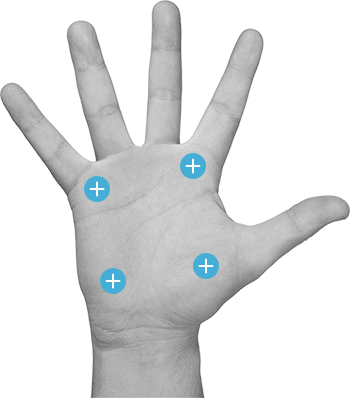
A quick evaluation of minerals and toxic metals in the palm of the hand.
Learn moreScreening of physiological imbalances helps better health control and trace minerals overall wellbeing.
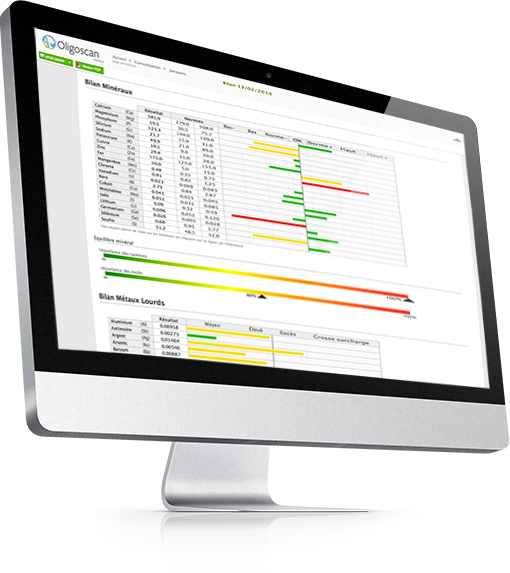
Excess and deficiency in minerals
A risk of toxic metals poisoning
Responsible for aging and numerous other diseases
Instant measurements of minerals, trace elements, oxidative stress and toxic metals.
Oligoscan can be used by all health specialists allowing for rapid and pain free analysis.
The measurement is taken directly by a portable spectrometer connected to a computer
The technology is based on spectroscopy
Evaluation of trace minerals reserves, the level of oxidative stress and toxic metals
Non-invasive measurement taken in situ
The record provided allows for detection of trace elements and minerals deficiencies as well as high rate of toxic metals in the body.
Oligoscan is now used by health professionals in many countries as a solution whenever a quick and accurate analysis of the level of trace elements, minerals and toxic metals is needed.
The Oligoscan uses optical technology : spectrophotometry.
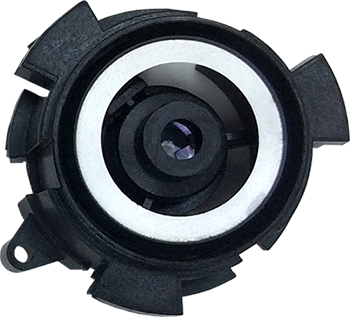
This is a quantitative analytical method of measuring the absorption or the optical density of a chemical.
It is based on the principle of absorption, transmission or reflection of light by the chemical compounds over a certain wavelength range.
Spectrophotometry is used in many areas : chemicals, pharmaceuticals, environment, food, biology, medical / clinical, industrial and others.
In the medical field, spectrophotometry is used to examine blood or tissue.
The Oligoscan is a reliable and scientifically proven tool..
A set of tests and comparative studies have been made by researchers highlighting a correlation between the results of the Oligoscan and those performed in the laboratory.
But this peace comes with a price tag that isn't measured in dollars. It is measured in exposure.
While these tools reduce false alerts by distinguishing a human from a blowing leaf, they also compile highly detailed profiles of your daily life, your guests, and regular delivery workers. As these biometric capabilities expand, the need for stringent user privacy controls and transparent data laws becomes more critical than ever. Security should never come at the cost of your fundamental right to privacy.
Most reviews focus on video quality and motion alerts. But after living with Ring, Eufy, and Google Nest cameras for six months, the most important feature isn’t 4K resolution — it’s .
While home security camera systems offer many benefits, they also raise important privacy concerns. Some of the key issues to consider include:
: Many regions follow "two-party" or "all-party" consent rules, which require the agreement of everyone being recorded.
Early home security relied on Closed-Circuit Television (CCTV) systems. These systems recorded video locally to physical tapes or hard drives.
Over-surveillance can strain community relationships. When neighbors feel constantly watched, it erodes trust and comfort. Transparent communication about camera placement is vital to maintaining neighborhood harmony. Best Practices to Protect Your Privacy
As consumer awareness regarding data privacy grows, the security industry is adapting. The future of home surveillance points toward . Manufacturers are increasingly adopting end-to-end encryption (E2EE) for video transmissions, meaning only the user's smartphone can decrypt and view the footage—not even the camera manufacturer can access it. Additionally, on-device AI processing allows cameras to analyze motion and detect events locally, eliminating the need to send raw video data to the cloud for analysis. Conclusion
Keeps facial recognition data off third-party cloud servers.
The Panopticon at Home: Balancing Security and Privacy in Residential Camera Systems
What is the target ? (tech-savvy users, beginners, renters?) Share public link
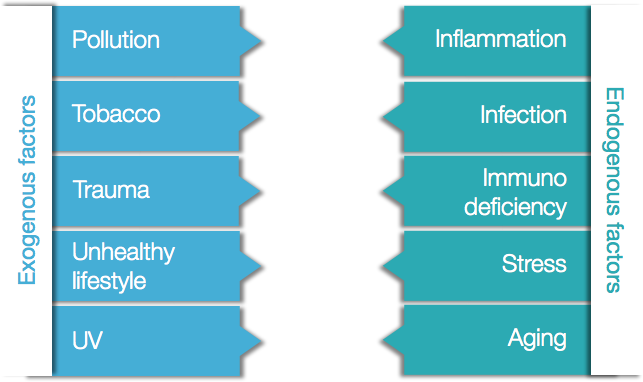
Free radicals are molecules produced in small amounts by the body. These free radicals are very reactive substances, capable of damaging the components of the cells (enzyme proteins, lipid membranes, DNA).
Their production is particularly stimulated by the exposure to sunlight (UV), tobacco, pollution, pesticides, etc.
A diet rich in antioxidants, particularly found in some fruits and vegetables, is essential in fighting free radicals.
Some scientific references :
But this peace comes with a price tag that isn't measured in dollars. It is measured in exposure.
While these tools reduce false alerts by distinguishing a human from a blowing leaf, they also compile highly detailed profiles of your daily life, your guests, and regular delivery workers. As these biometric capabilities expand, the need for stringent user privacy controls and transparent data laws becomes more critical than ever. Security should never come at the cost of your fundamental right to privacy.
Most reviews focus on video quality and motion alerts. But after living with Ring, Eufy, and Google Nest cameras for six months, the most important feature isn’t 4K resolution — it’s .
While home security camera systems offer many benefits, they also raise important privacy concerns. Some of the key issues to consider include:
: Many regions follow "two-party" or "all-party" consent rules, which require the agreement of everyone being recorded.
Early home security relied on Closed-Circuit Television (CCTV) systems. These systems recorded video locally to physical tapes or hard drives.
Over-surveillance can strain community relationships. When neighbors feel constantly watched, it erodes trust and comfort. Transparent communication about camera placement is vital to maintaining neighborhood harmony. Best Practices to Protect Your Privacy
As consumer awareness regarding data privacy grows, the security industry is adapting. The future of home surveillance points toward . Manufacturers are increasingly adopting end-to-end encryption (E2EE) for video transmissions, meaning only the user's smartphone can decrypt and view the footage—not even the camera manufacturer can access it. Additionally, on-device AI processing allows cameras to analyze motion and detect events locally, eliminating the need to send raw video data to the cloud for analysis. Conclusion
Keeps facial recognition data off third-party cloud servers.
The Panopticon at Home: Balancing Security and Privacy in Residential Camera Systems
What is the target ? (tech-savvy users, beginners, renters?) Share public link