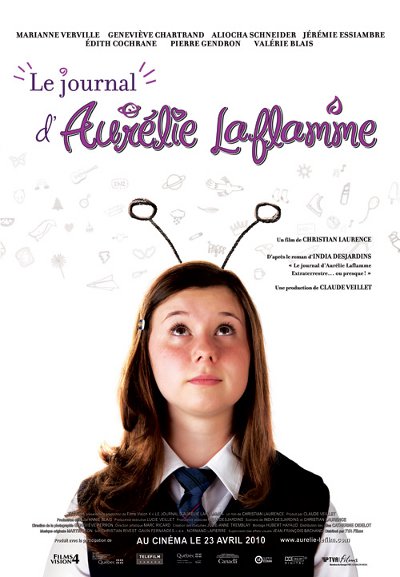
Journal d’Aurélie Laflamme, Le – Film de Christian Laurence

Le Journal d’Aurélie Laflamme est une comédie pour adolescents dont le personnage principal est tiré de la populaire série de livres écrits par l’auteure India Desjardins.

Le journal d’Aurélie Laflamme de Christian Laurence

Le journal d’Aurélie Laflamme de Christian Laurence

Le Journal d’Aurélie Laflamme est une comédie pour adolescents dont le personnage principal est tiré de la populaire série de livres écrits par l’auteure India Desjardins. Ce film est basé sur le premier tome de la série « Aurélie Laflamme, Extraterrestre ou presque ». Le réalisateur Christian Laurence vient du domaine de la télévision et signe ici son premier long-métrage de cinéma.

Comme on pouvait s’en douter d’après les succès obtenus par les livres, Le Journal d’Aurélie Laflamme fut reçu chaleureusement par le jeune public québécois qui en fit l’un des succès au box office de 2010. Au niveau international, le film de Christian Laurence eut droit à quelques sélections dans les festivals francophones, sans toutefois se démarquer outre mesure.

Un second film tiré des aventures d’Aurélie Laflamme a été produit par la suite.

Résumé

Aurélie est une adolescente de 14 ans, un peu perdue et donc en quête de solutions. Entre les habitudes de sa mère sédentaire et les chicanes avec sa meilleure amie, elle rêve à son premier french kiss ! Mais au fond, Aurélie se sent bien seule dans l'’univers, surtout depuis la mort de son père, il ya 5 ans.

Et si son père était simplement un extraterrestre, ayant quitté la Terre pour rejoindre sa planète? Génétique oblige, Aurélie serait elle-même une extraterrestre! Ceci expliquerait bien des choses. Par exemple, pourquoi elle se sent si différente des autres (surtout de sa mère), pourquoi elle n'’est pas capable d’'enligner deux mots sans faire une gaffe, et surtout pourquoi les garçons lui tapent vraiment sur les nerfs.

Synopsis officiel

Distribution

Marianne Verville (Aurélie Laflamme) ; Geneviève Chartrand (Kat) ; Aliocha Schneider (Nicolas) ; Jérémie Essiambre (Truch) ; Edith Cochrane (mère d’Aurélie) ; Pierre Gendron (Denis Beaulieu) ; Valérie Blais (Marie-Claude) ; Sylvie Potvin (Soeur Rose)

Fiche technique

Genre: Comédie dramatique - Origine: Québec, 2009 - Sortie en salles: 23 avril 2010 dans 83 salles au Québec - Durée: 1h48 - Classement: Général - Tournage: septembre-octobre 2009 - Budget approximatif: 4,1 M$

Réalisation : Christian Laurence - Scénario : Christian Laurence et India Desjardins, d'après le roman éponyme d'India Desjardins - Production : Claude Veillet et Lucie Veillet - Société de production : Films Vision 4 - Distribution : TVA Films

Équipe technique - Costumes : Julie-Anne Tremblay - Direction artistique : Marc Ricard - Montage : Hubert Hayaud - Musique : Martin Léon - Photographie : Geneviève Perron
He swings harder. The camera cuts to a close-up of a crack forming along the wall of the pit, just above José’s head. Then, a long shot of the pit from above: it looks like an open wound in the earth. For a moment, there is silence. Even the birds stop singing.

As he accumulates the gold, his greed overpowers his fatigue. He ignores the creaking structure of the mine and the rising dust. He stuffs his pockets, his bags, and his hands with the yellow metal. He is no longer just a man digging; he is a man possessed, his eyes wide with the manic glint of "gold fever."

She believes Facundo and his rural estate are her "gold mine"—a ticket to a comfortable, loved future.

This public link is valid for 7 days and shares a thread, including any personal information you added. This link or copies made by others cannot be deleted. If you share with third parties, their policies apply. Can’t copy the link right now. Try again later.

The dark twist unfolds as Betina realizes the horrifying truth. There is no gold mine. The "gold mine" is Betina herself. Alfonso and his family are human traffickers who lure lonely women online to harvest and sell their organs. The film ends on a chilling note as Betina is trapped, realizing too late the cost of her blind trust. Key Themes

La Mina de Oro received widespread acclaim in the international film festival circuit, winning several awards for best short film and screenplay. It is frequently studied in cinema classes for its tight pacing, economic storytelling, and masterful execution of a narrative twist.

La Mina de Oro is a recommended short film for anyone who appreciates compact, tightly-written narratives with surprising endings. It is a story about second chances, the mirage of the internet, and the unexpected value of digging for gold in places we least expect.

The core of the narrative relies heavily on situational irony. Beto’s absolute certainty that his life is taking a turn for the better makes his sudden, inescapable downfall deeply unsettling for the audience.

Watch the award-winning short film directed by Jacques Bonnavent below: Bonnavent, Jacques - La mina de oro [2010] YouTube• 3 Aug 2011 The Gold Mine (La Mina de Oro) - Reel Shorts Film Festival

Won the Jury Award for Best of the Festival at the 2010 Palm Springs International ShortFest and Best Short Fiction Film at the Morelia International Film Festival. Symbolic Meaning of the Title The title "La Mina de Oro" is deeply ironic.

The film also explores the psychological effects of living in poverty, where the constant struggle to survive can lead to feelings of hopelessness and despair. As the miners dig deeper into the mine, they are forced to confront their own mortality and the possibility that their quest for gold may be nothing more than a futile attempt to escape their circumstances.

Directed by Jacques Bonnavent, the 2010 Mexican short film La mina de oro